The bar for customer interaction is higher than ever. Tenants expect speed, convenience and a personal approach, while housing associations are facing increasing workload and limited capacity. That's why it's essential to properly organize digital customer journeys and connect them to human contact, so that efficiency and personal service go hand in hand. In conversation with CorporatieGids Magazine, Ties Arts, director of Embrace, explains how housing associations can provide efficient and empathetic services: “Only if you oversee the entire customer process and take control, can you make a difference.”
New director: Ties Arts
We would like to welcome Ties Arts as the new director of Embrace. Ties comes over from ViaData, where, as director, he got to know the processes and challenges of housing corporations like no other. ViaData is the software platform for planning and coordinating repairs and inspections by professionals — always fully up to date with the Service App. Ties remains active for ViaData.
With over 13 years of experience at Microsoft, and previous positions at Sitecore and Reeleezee (now part of Exact), Ties brings a wealth of knowledge and experience from the software industry. He will use them to take Embrace and our solutions — Social Intranet, CRM and housing distribution system — to the next level.
In your opinion, what are the biggest frustrations of tenants when it comes to contact their corporation?
Tenants often experience two main frustrations: lack of direction and fragmented communication. Reports are sometimes not or incompletely fed back, so the tenant feels like they always have to take the initiative themselves. In addition, reports often go through different employees or channels, so tenants have to repeat their story multiple times. Sixty percent of customer interactions involve daily maintenance — things that need to be handled quickly, predictably, and without frustration.
You advocate for one consistent customer journey, regardless of channel or party involved. What does that mean and what is the benefit?
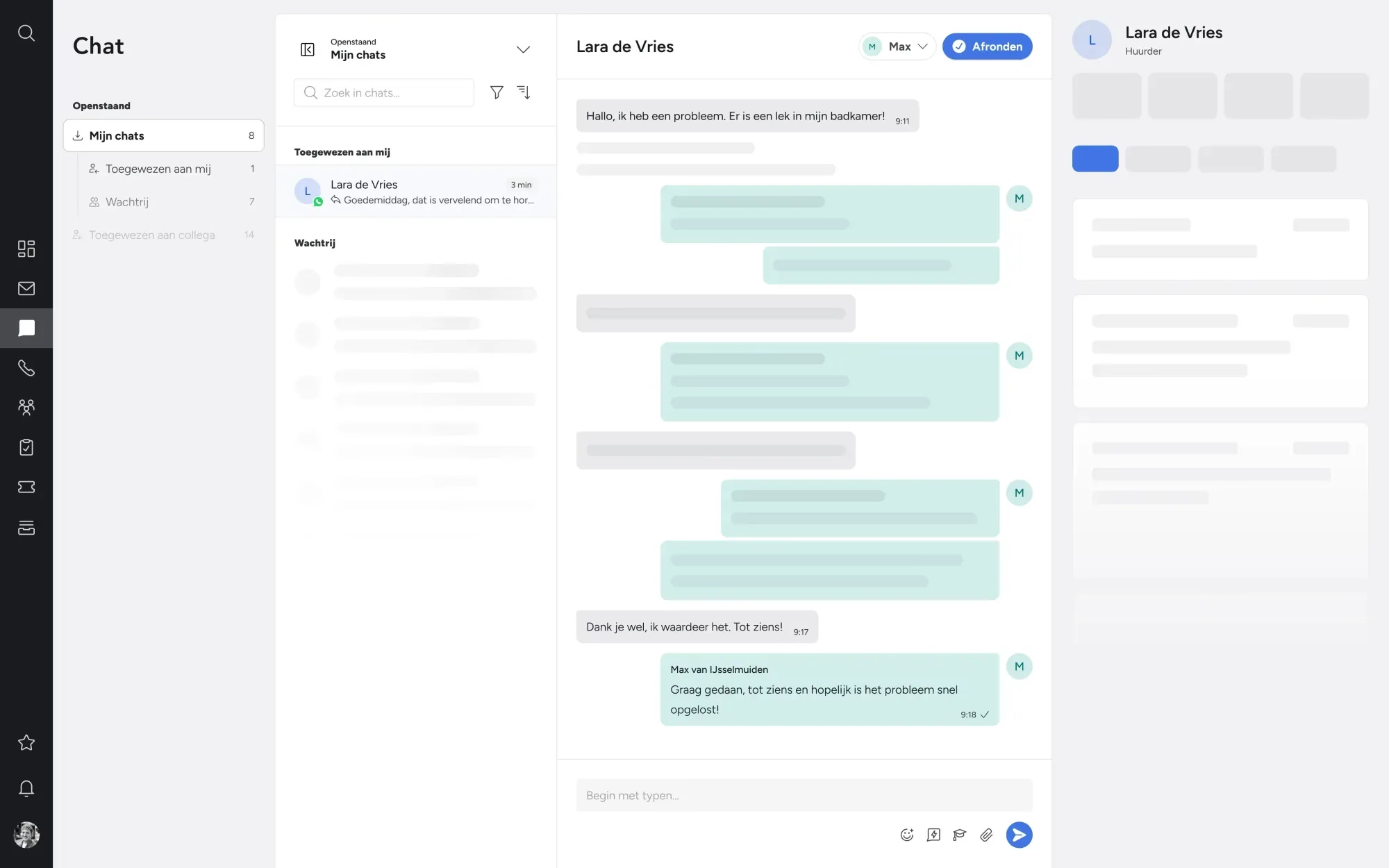
A consistent customer journey means that tenants have the same familiar and predictable experience, tailored to their needs, at every touchpoint — by phone, email, app, portal, or in person. Regardless of who picks up the report, the process must be logical, fast and clear. At a time when expectations for digital services are high, such a consistent customer journey is crucial.
Why is it important that tenants do not experience the “organizational back”?
The internal structure of corporations is often complex, with multiple departments and external parties. When a tenant experiences this complexity — for example because he is forwarded or receives conflicting information — irritation and uncertainty arise. Take, for example, a tenant who reports moisture problems but does not receive follow-up or insight. This leads to ambiguity and frustration about who is responsible.
You are focusing on a shift from customer contact to predictable service. What does that mean?
This shift means that corporations do not wait for reports, but use data to predict what tenants need and anticipate them. Think of a corporation in a neighborhood with many moisture reports that takes action in advance, or proactively calling older tenants who ask the same question every year. The 80/20 principle applies here: most of it is routine and can be dealt with quickly and efficiently, while the other - often more complex - contact is handled in a case-oriented manner and with more personal attention.
What does it take to make this shift possible?
First of all, all parties involved must work with the same data: one shared customer view. In addition, customer journeys and processes must be central. A process involving a repair report or rental cancellation should not be built around a department, but around the customer. This requires leadership and space for teams to take ownership.
How does Embrace help housing associations with this?
The combination of Tobias365, Embrace, Connect-IT 365, Mareon and Luxs forms a powerful, coherent chain that helps housing associations take customer interaction to the next level. Embrace acts as a director and facilitates interaction with tenants. Tobias365 provides reliable tenant and home data. Connect-IT 365 ensures the efficient use of people and resources, both internally and externally. Mareon streamlines the order chain towards chain partners. Luxs maps patterns and risks based on real estate data. This integration enables fast processing, better insight and more efficient customization via one interface.
What role do AI and data models play in predicting customer inquiries or maintenance requests?
AI and data models make the difference between responding to a report and preventing it from occurring. A concrete example: reports about mold and moisture come in via Embrace. AI detects that it concerns multiple homes in the same porch flat, with identical orientation and year of construction. The system automatically links these reports to a cluster case, which can be addressed by a contractor in one go. For example, AI does not provide ready-made answers, but valuable insights that teams can act on immediately.
.avif)
How will customer contact at housing associations develop in the coming years?
Customer contact is becoming both more personal and efficient, with clear trends. Case-oriented work is becoming the norm. Artificial intelligence helps prioritize and prevents unnecessary notifications. The 80/20 rule ensures that most of it is dealt with automatically and that complex cases receive the right attention. Chain partners are given a greater role in the customer journey, with real-time insight and responsibility, and are also assessed on customer experience. Continuous monitoring and adjusting customer contact processes will become standard. For example, corporations continue to improve their services and work on an optimal experience for their tenants.
Source: Corporate Media Guide
Wil je Embrace liever van binnen bekijken?
Meer weten over dit onderwerp?