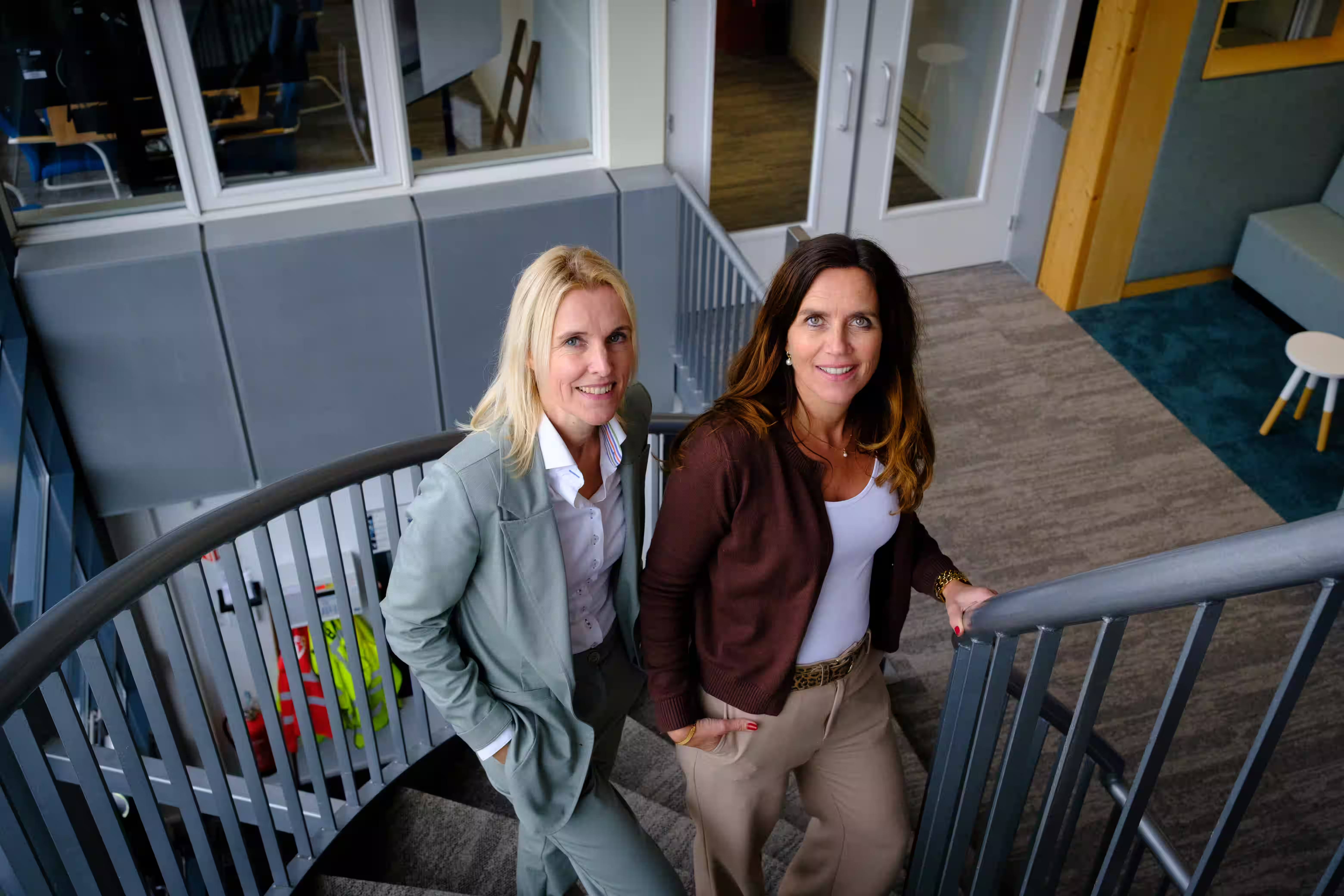
The tenants of a housing association are often a good reflection of society in their diversity: young and old, digitally and less digitally savvy and with different backgrounds. This leads to a variety of wishes and expectations, which makes good customer contact a profession in itself. In conversation with CorporatieGids Magazine, Daniëlle Rozemond, Customer and Facilities Center Team Leader, and Marieke Otten, KCC Quality Officer, from Intermaris talk about how the corporation has organized its customer contact, what role digitization plays in it and how the focus is shifting to more efficient, but also more personal services. “Digitization helps us work faster and gain more insight, but it's still human work.”
“The biggest customer contact challenge is not technology, but dealing with people,” Daniëlle starts the conversation. “Getting a frustrated or angry tenant to calm down requires patience and empathy. In practice, we notice that people are becoming increasingly empowered and then the KCC can sometimes get the full layer. In addition, you are often dependent on your back office. If they do not call back or email by appointment, the front office is often the first to hear it. Dealing with that in a good way remains human work.”
The core of customer contact
Intermaris is a large corporation with approximately 17,000 VHE in various cores. “That means that we are dealing with a diverse target group,” explains Marieke. “We're dealing with a lot of different people, cultures and ages. That is why we need to pay extra attention to certain groups, such as elderly people or non-native speakers who prefer to contact us at the counter. But no matter who or how we interact with, the core is that we try to help the customer in a way that is most comfortable for them. This means that where things can be done quickly, we use the right - often digital - channels. But when it's necessary to make time to talk to the customer, we can also offer that space.”
Channel Strategy
In order to offer that space, Intermaris works with a channel strategy. Daniëlle: “We offer tenants many options via a self-service scenario (SSS). In addition, they can call, chat and email us. We deliberately do not choose WhatsApp because we prefer that our tenants go to the website to find information and they can also chat with us there. In addition, WhatsApp is an additional channel to handle. Finding the right balance is sometimes quite difficult, but we do try, for example, to send tenants to the SSSs by saying in the telephone queue that things can be arranged online. This is how we hope that people are not on hold for too long. In addition, our average waiting time throughout the year is less than two minutes, something we are very proud of.”
“We don't actively promote the use of email, because we'd prefer tenants to fill out an SSS. It contains the right questions and the request goes directly to the right department. But we can't do without email at all. It is often used to record things to the tenant if, for example, we have stopped by for a leak or an inconvenience situation. It is then a useful medium for recording what has been discussed or agreed upon.”
Better insight into customer contact
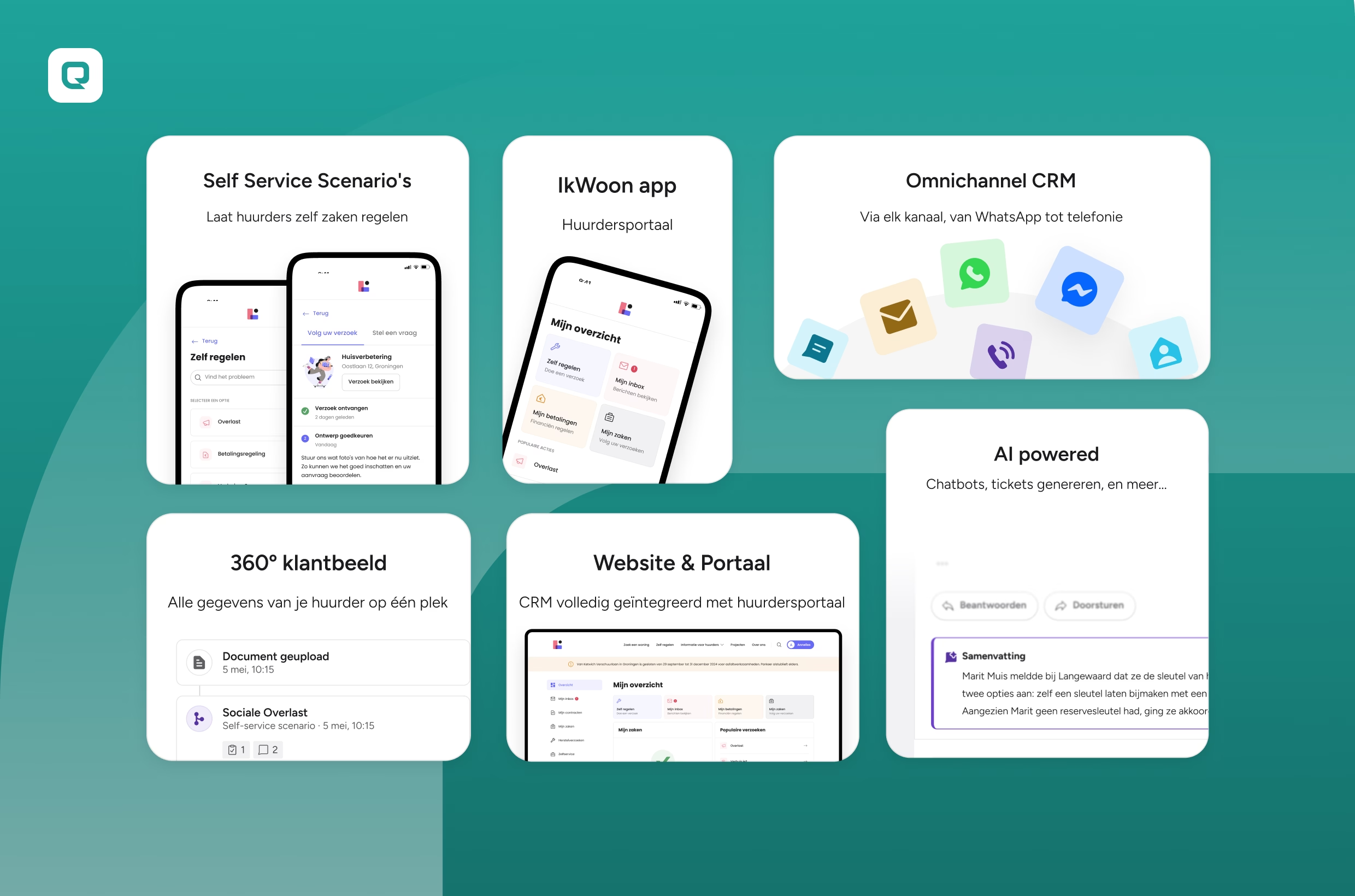
Intermaris uses two main systems when contacting tenants, explains Marieke: “We use Embrace for the e-mail, the website with SSS's and chat, and the telephony is via Unexus. This includes a link so that during a telephone conversation, the number is linked to a tenant via Embrace. We have also been using a new e-mail module since April. This links the incoming mail directly to the customer card, and everyone within Intermaris can easily email back from the customer card. We can then transfer the e-mail to the second line as a task. This way, all correspondence is clearly arranged on the customer's timeline and you can't forget to save conversations.”
Bring colleagues
“An important part of adopting the module was bringing colleagues along,” Marieke looks back. “We introduced it to the KCC because that's where we work with it the most. This means that you include everyone in the use, give a good explanation of why you are doing it, highlight the benefits and highlight the effects for other departments. We deliberately put time into this at the front end by training and training colleagues and see that things are getting better and better. And with success, because it increases colleagues' job satisfaction and improves the experience of our tenants. Now it's important to keep repeating this until everyone has adopted it.”
Standard answers
When asked whether Intermaris uses AI in its customer contact, Daniëlle shakes no: “We're not working on that at the moment, a conscious choice to take advantage of later — when the applications have proven themselves — perhaps to piggyback. What we do do is work with standard answers. These are in Teams and link to our knowledge base. This way, colleagues can give a quick and uniform answer when appropriate, but this is still done manually.”
Improvement team
Not only the technology, but also the user experience of tenants is continuously reviewed. Marieke: “We work with an Improvement Team where all ideas and wishes from the organization are discussed and developed. Last year, we also had a survey carried out among our tenants to see where we can further improve ourselves. A good example of this is how we now deal with keys for the general entrance door. This used to be requested, ordered and someone could pick it up and pay for it at our counter. But that meant a mountain of keys in the office that were sometimes not picked up at all, which meant unnecessary costs for us. Now this process runs via an SSS and the tenant pays directly via iDeal. We notice that the number of keys that remain lying around has decreased enormously as a result.”
Daniëlle nods and continues: “Another example is a scenario that we are going to create about housing. A tenant can request online whether someone can live with them temporarily, which makes the process clearer and faster for them.”
More online, more space
“I expect online contact to continue to increase in the coming years, and the share of telephony will decline,” concludes Daniëlle. “We are already seeing this happening, and by offering SSS and channel control, it is expected to happen faster and faster. But customer contact in all ways will continue to exist, something we will continue to respond to when training our KCC employees. In addition, the increase in digital contact will free up more and more time for more complex conversations, for example on the phone or at the counter, and we will have more time at the KCC to sort things out properly. That also makes a difference for the second line, because it reduces the pressure on the back office.”
Source: Corporation Guide Magazine, Photo: Marjolein Bijpost
Wil je Embrace liever van binnen bekijken?
Meer weten over dit onderwerp?